
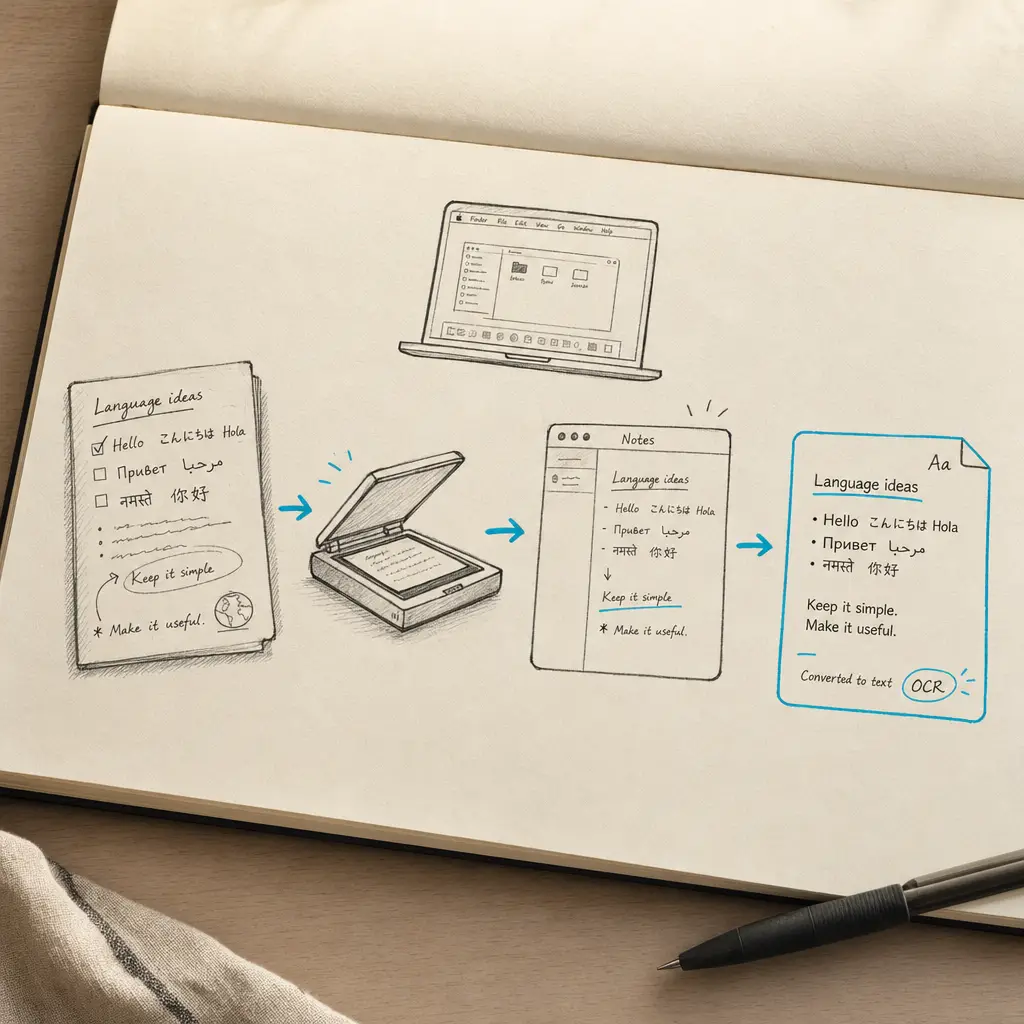
There is no “convert handwriting to text” button in macOS. Unlike an iPad with an Apple Pencil, the Mac has no built-in handwriting recognition. What it does have is a few general tools that can sometimes read clear printing, and a very good way to get paper documents onto your screen.
This guide covers what those native tools actually do, where they run out of road, and the faster, more accurate route we see people take when they have real handwriting to digitise.
Quick answer
- macOS has no native handwriting-to-text feature. Preview’s Live Text is the closest thing, and it is built for printed text.
- Live Text does OK on clear block printing, one page at a time; it struggles with cursive, messy or faded writing, and has no multi-page workflow.
- Use Continuity Camera to scan paper straight onto your Mac as a PDF.
- For accurate results on real handwriting, upload or email that PDF to Handwriting OCR and the text lands in your dashboard in about 15 to 20 seconds.
The native Mac options (and their limits)
Preview Live Text
On macOS Monterey and later, open an image in Preview, then select text directly in the picture and copy it. It is genuinely handy for a printed label or a tidy note.
Live Text was built mainly for typed text, though. On real handwriting its accuracy falls away quickly, especially with any cursive or joined writing, and it can only work on one image at a time.
Continuity Camera (for getting paper onto your Mac)
Continuity Camera is the best native part of this workflow. On your Mac, choose File, Import from iPhone or iPad, Scan Documents, and your iPhone captures the pages and drops them onto your Mac as a clean, multi-page PDF. This does not convert handwriting on its own, but it produces the ideal file to hand to an OCR tool.
Apple Notes and Google Drive
You can also route through Apple Notes (handwriting written on an iPhone or iPad with an Apple Pencil, synced to your Mac) or upload an image to Google Drive, which runs OCR when you open it as a Doc. Both are print-oriented and drop off sharply on handwriting.
Where the built-in tools run out
We process thousands of real handwritten documents every week, so we see exactly where these general tools stop being enough. In practice:
- They do well on neat, block-printed handwriting in a clear, well-lit image.
- They struggle with cursive, joined or mixed writing, cramped or hurried notes, and faded ink.
- They have no multi-page workflow, so you are copying and pasting one image at a time.
If your writing is clean and you only have a page, the native tools are fine. The moment you have more than that, and the accuracy isn’t good enough, it is worth using a tool built for the job.
The faster route: send your PDF to Handwriting OCR
Handwriting OCR is built specifically for real-world handwriting, cursive included, and it is materially more accurate on handwriting than Apple Live Text or Google Drive OCR. It reads over 300 languages, handles whole multi-page documents in one pass, and runs in your browser with nothing to install.
On a Mac you have two easy routes.
Upload in your browser
- Scan the pages with Continuity Camera (or any scanner) to a single PDF.
- Open Handwriting OCR in Safari and drop the PDF or image in.
- Export the result to Word (DOCX), PDF, plain text, or JSON.
Or email the PDF straight in
Once email submission is switched on in your settings, you get a private inbox address of your own. Email the scanned PDF to it as an attachment, and the finished transcription appears in your dashboard, tagged with an Email badge, usually within 15 to 20 seconds.
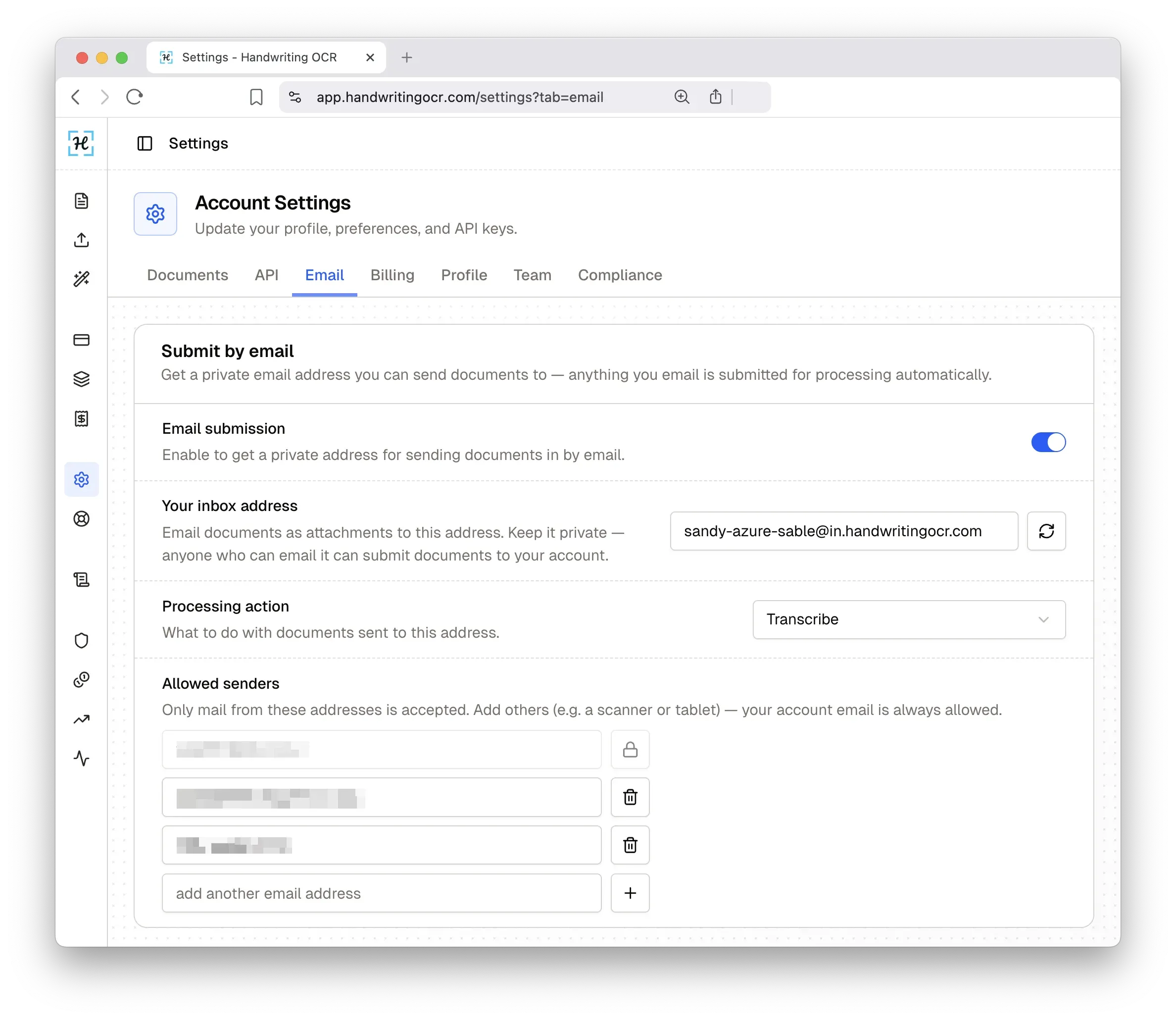
It costs one credit per page, and free-trial credits work too, so you can test it on your own worst handwriting before committing. Your documents are encrypted, auto-deleted after 7 days by default, and never used to train models. (Results appear in your dashboard rather than as an email reply.)
When to use which
| You have… | Best tool |
|---|---|
| A tidy, block-printed image | Preview Live Text |
| Cursive or messy handwriting | Handwriting OCR |
| Several pages to digitise | Handwriting OCR (scan then upload or email) |
| Faded or low-contrast ink | Handwriting OCR |
| Paper you need to get onto your Mac first | Continuity Camera, then Handwriting OCR |
For a clean single page, Preview has you covered. When the handwriting gets harder or the pile gets bigger, try Handwriting OCR free and send your first document straight in.
If you also work across Apple devices, see our guides for iPhone and iPad.
Frequently asked questions
Does macOS have built-in handwriting recognition?
No. Unlike iPad with an Apple Pencil, macOS has no native handwriting-to-text feature. The closest built-in tool is Preview's Live Text, which can extract text from an image but is designed for printed text and is unreliable on real handwriting.
Can Mac Preview convert handwriting to text?
Preview's Live Text (macOS Monterey and later) can select and copy text from an image, and it works on very clear, block-printed handwriting. It struggles with cursive, hurried, or faded writing, and it has no multi-page workflow. For those, a dedicated handwriting OCR service is far more reliable.
What is the most accurate way to convert handwriting on Mac?
Use a dedicated handwriting OCR service in your browser, no install needed. Handwriting OCR is materially more accurate on handwriting than general-purpose tools like Apple Live Text or Google Drive OCR, reads over 300 languages, and handles cursive and multi-page documents. You can email a PDF straight to it or upload it in Safari.
How do I scan a handwritten document on a Mac?
Use Continuity Camera: on your Mac, choose File then Import from iPhone, and Scan Documents. Your iPhone captures the pages and they drop straight onto your Mac as a PDF. Send that PDF to Handwriting OCR by upload or email to get accurate text back in your dashboard.